Please Read: Details on entering the Game Design Showdown.
This Challenge has been completed.
Congratulations to the winner of this month's Game Design Showdown with 8 votes:
Congratulations to the runners up as well, tied at 6 votes apiece:
Theme Restriction: Home Improvement.
The theme of this month’s GDS is remodeling or renovating a home. There is no Mechanics restriction perse, but the game must feature each of the following aspects in some way:
To be clear, each of these restrictions should be addressed, but while some may be the focus of the game, others could be addressed peripherally. I don't expect to see a single game focusing on each and every one of these items in detail!
A game for 2-5 players
Playing time: 90 minutes
Game mechanics: point-to-point movement, economic, negotiating, commodity speculation
A game about investing in and renovating properties.
Players begin with an income of $200k from your current employment. You work 8 hours a day, leaving another 8 hours for investing and renovating. If you can quit your job and live off of rents alone this gives you additional freedoms and advantages when buying, selling, bidding, as well as first shot at short sale situations.
You can borrower money from a bank at a certain rate of interest. When another player borrows money, rates go up. When a player pays off a loan, or when borrowing is slow, rates come down.
24 single family residences.
16 2-family properties.
8 4-family properties.
There are 6 different districts of the residential city of Homewood. Each time a person buys a property in a district, the values of the other properties go up. If a property is sold, the value of the properties goes down.
If a player is unable to pay their mortgage from shortage of funds or job loss (event card), the home is under foreclosure and short-sale. While short-sales takes longer to acquire, they can be purchased at a great discount.
Different paths to victory and victory points: players can spend their time buying and selling properties. They can also renovate the properties they own, which adds value to the surrounding properties in the district, as well as increase rents from rental properties.
There is also a General Event deck that happens in phase 4, possibly affecting everyone or only a certain district of properties.
Further details:
Players pay any mortgages they’ve taken out, plus real estate taxes (see district chart)
An event card is drawn which announces something that may affect a player, all players, a district, a particular home, a job, or a market. Some examples:
At the beginning of the game, a pool of victory points is placed next to the game board depending on the number of players. In Phase 5, players acquire victory points based on:
District number: District1 ----- District2 ----- District3 ----- District4 ----- District5 ----- District6
One family rent: $1550 ------- $1475 ------- $1400 ------- $1325 ------- $1200 ------- $900
Two family rent: $1200 p.u. --- $1150 p.u. --- $1100 p.u. --- $1050 p.u. --- $950 p.u. --- $700 p.u.
Four family rent: $1000 p.u. ---- $900 p.u. ---- $800 p.u. ---- $700 p.u. ---- $600 p.u. ---- $400 p.u.
Real estate tax : $3000 ------- $2500 ------- $2000 -------- $1500 -------- $1000 -------- $1000
Carcassone meets the Tom hanks movie
Each player controls a couple who, are trying to repair their homes, after excessive damage was done while trying to remodel. It is a tile-laying sort of game, where each house has two floors - a main floor and a basement. Each turn, players expand onto their homes, but also suffer from disasters as other parts of their home break. You may pass which results in no expansion or disaster. If all players pass, the next round must be complete (no passing).
Expansion and repairs cost money. Each player starts with a fixed amount of money, with more money coming in at set intervals. Some repairs require the use of a electrician or a plumber, of which there is only one in the game. The electrician and plumber each are available to be used only by the player with the worst wiring, or worst plumbing, respectively. Ties are settled with bidding.
Players start with a pre-set house, along with a choice of remodeling plans. You can add a kitchen, a bedroom, a bathroom, or a patio with a hot tub. Each kind of expansion has an associated potential victory value.
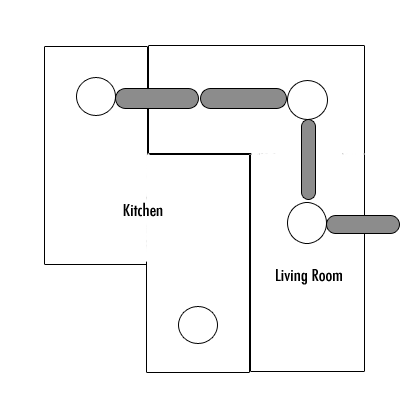
The game ends with the first player who completes their expansion and has it in working order. This player gets a victory bonus. Other than the victory bonus, scoring is based on adding up points for all tiles in your home, according to completed systems. Here is an example of how scoring may go:
All plumbing and wires are placed with a tile system in the basement, rooms are on the plans already and must be laid out as shown. Appliances may be placed anywhere in their respective rooms, and should match up to a subsystem in the basement.
Make the most money by building the best house in the neighborhood.
Each player receives 3 workers, $20, and a Headquarters and Building card. Each player randomly draws a “Neighborhood Association” card. Place the Day Labor, Rock Quarry, Lumber Yard, Supply Yard cards in the middle. Each player then looks through their building deck, and secretly decides on their set of rooms (their plans). For example, a player may take “Wooden Bedroom,” “Stone Master Bedroom,” “Bathroom,” “Second Bathroom,” “Basic Kitchen,” “Medium Living Room,” “Superior Grass Lawn,” and “Olympic Sized Swimming Pool with Waterfall.” Once this has been done, each player reveals their plans, and players randomly select an early bird player.
The turn starts with worker placement. The early bird player (the person who was to the left of last turn’s early bird) may place a single worker on any of the 6 possible areas. Next the player to her left does the same, and so on. Once each player has placed all 3 workers, players are given the option of hiring temporary workers at the price of $10. Play continues in a circle, with each player allowed to hire as many temporary workers as she likes (one at a time). Temporary workers act just like regular workers, except are returned to the labor pool at the end of your turn. Work things out in the following order:
If you have a worker in headquarters, you may change you plans. You may place a new room card or remove a card at the cost of $2 per card. If you remove a room that you have already begun room, half of the resources return to your hand (rounded down), and half return to the bank. Additionally, for every room that you have begun building which you do not change, you must pay $2 and 1 worker for alterations (alternatively, you can have a “quick fix,” by paying $6 and 1 worker for 2 rooms).
Each room has a certain cost, a timing of resource costs, and a certain amount of time on it. For example, building a Delux Kitchen requires 3 time, and 2 wood, 3 stone, 2 copper, and 2 money (order: 2s-1w, 1s-1c, 1w-1c-2$). This means the first time a worker begins working on the Deluxe Kitchen, you must pay 2 stone and 1 wood. The second worker must pay 1 stone and 1 copper, and so on. You can have multiple workers working on the same room at the same time (so, if you had 3 workers and all the required resources, you could build a Delux Kitchen in 1 turn).
For each worker you have as a day laborer, collect $5.
At the beginning of each turn, draw two cards for each area. Cards will name some number of resources, and a minimum bid (for example, “3 Lumber: Min. Bid $2”). Starting with the first player who placed in that area, that player is able to bid on one of the cards (if she has 2 workers, each may bid on different cards). The next player may then bid on one of the cards. Play proceeds in the order in which workers arrived. A player must increase the current bid by at least $1, bid on the other card, or leave. When everyone has had a chance to bid, the player who bid the highest for each card pays that money to the bank, and takes that resource tokens. Players buy wood from the lumber yard, stone from the rock quarry, and copper piping (for the plumbing) from the supply yard.
At the end of the turn, players are allowed to trade resources, money, or worker. If a player trades a worker, then that player loses one worker during the next turn, and the other player receives a “free” temporary worker. Resources do not need to be traded for the amount on the card (e.g. if you bought a “5 Wood” card this turn, you can trade each wood token individually).
The game ends on turn 10. At the end of the game, each player may sell wood for $1, stone for $2, and copper for $3. Each room has a “Selling value.” Each player collects that much money if the room is complete. Rooms also have an “Unfinished penalty.” If the room is not completed, the player loses that much money. Neighborhood association cards give several bonuses (such as “If you have 4 small bedrooms and 4 bathrooms, +$20”), and penalties (“If you don’t have a finished bathroom, -$20”). Whoever has the most money at the end wins. In the event of a tie, the player with the highest value house wins.
As a contractor you have been hired to remodel a specific part of someones home. You do not like the idea of working with other contractors, but the home owner insists on having different contractors. It is your job to finish your assignment in a timely manner, with out to many disruptions. Its not about finishing first, its about how good of a job you did, how much money you made and how satisfied is your customer, and the customer insist on not paying until everyone's jobs are done, so try and help your fellow contractors.
6 Floor pieces,
16 Client Cards,
12 Permit Cards,
36 Floor Plans Cards,
32 Worker Cards,
80 Material cards,
30 day to day cards,
30 Hazard Cards,
100 Yellow Coins,
60 color beads (20 red for a Crappy job, 20 Blue for a Normal job and 20 Gold for an Outstanding job)
The house renovation business is booming, and construction companies are eager to win remodeling contracts and become the most respectable company in town. Company owners try to bid lower than others to win contracts, but if they can't fulfill their end of the deal, they won't get fully paid and will lose the respect of the townspeople.
The game board contains the following sections: - Coffee shop, with four tables, numbered 2, 3, 4, 5 (where subcontractors are recruited for jobs) - Office, a place for property and renovation cards (each property card space has three spaces beneath it for renovation cards to be placed) - Bank, a place for the money to be stored - Newspaper office, a place for the Respect Point chits to be stored
The game is played over a series of rounds with five steps until one player reveals a total of 10 Respect Points: - Reveal contracts and subcontractors - Bid and award contracts - Recruit subcontractors - Pay contract costs, receive earnings and points - Check for win and cleanup
Players bid blindly and simultaneously on one or more projects by writing on the bid tokens. A bid must include the property number and an amount rounded to the nearest $50. Players should consider all the costs of the project (fees, wages, materials) before making their bids. When players are finished, bids are revealed starting with the first property. The lowest bidder wins the contract. In case of a tie, the player with the most respect points wins. If still tied, the two players rebid, using lower amounts. Continue with the other three properties. Any property not receiving a bid remains in the office for the next turn and receives a +1 point chit.
In player order, players may pass or take all of the meeples from one of the tables in the coffee shop.
In player order, players pay for all of their contract costs:
When players pay for the costs of their project, they are awarded the earnings and Respect Points. Additional Points are awarded for using higher quality materials. If a player fails to pay for the contract costs, the player receives negative Respect Points associated with the property, but still receives half of the earnings (rounded down to the nearest $50).
If any player has 10 or more Respect Points, the game ends, and the player with the most points wins. In case of tie, the player with the most cash wins. If play continues, perform the following cleanup actions:
(2-4 players)
Billionaire Clayton McMansion wants a new home, something with fancy trimmings and Italian marble. The object of the game is to collect parts and plans and construct the most elaborate home for Clayton.
Game turns are broken down into two phases, Bidding and Building.
Collect Income - At the start of the bidding phase, give each player five coins to use in the bidding.

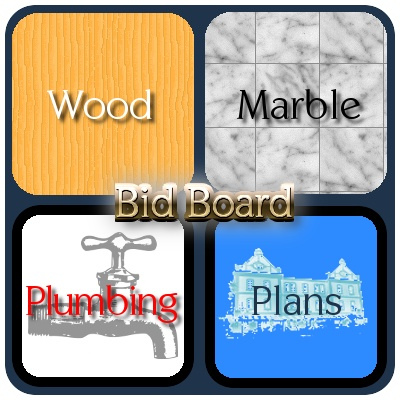
Placing Bids - In the bidding phase, each player secretly places coins onto his or her bid board. Players may allocate coins in whatever way desired, including leaving areas empty. Players need not spend all of their coins and may save for future turns. When finished bidding, players covers their bid boards. When all players are finished, they reveal their bids.
No Bid Means No Reward - If players do not bid in an area, they do not take part in that area and receive no resources.
Building Materials - The bids for the three building materials (wood, marble, and plumbing) are resolved as follows, depending on the number of players in the game:
If there is a tie, both players get the value for the tied rank, and the next lowest rank is skipped.
Plans - For the plans bidding, players get their pick of the four plan cards shown on the table in order of their bids. In case of ties, whichever tied player is closest to the Starting Player (going clockwise) picks first.
Finishing up - When all bids are resolved and players have collected their rewards, dump their bids in the coins pile and replace any plans cards taken by players with cards from the Plans deck, up to four.
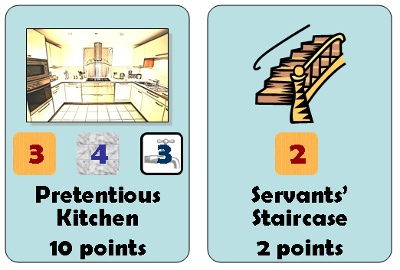
New Construction - Beginning with the Starting Player, each player may build from his or her plans. Each plan card lists the costs for building. If the player has the resources required, he or she may pay those resources to add that room or staircase to his or her mansion, played face up, arranged in rows representing floors.

Building Codes - Players must follow these rules in constructing their mansions:
Let’s Make a Deal! - Players may trade materials, coins, or plans with others. Trading is restricted to resources the player currently owns. Trades can be made at any time.
Finishing up - when all players have had an opportunity to build, the Building phase is over. Advance the Turn Indicator pawn to the next space. After 20 turns, the game is over; calculate scores and determine the winner. Otherwise, continue the game by starting a new Bidding phase.
The game ends after 20 turns. Scores are calculated as follows:
The player with the highest total score wins the game.
Summer is fast approaching, and life in the Sun Belt suburbs is all about showing off your money by having massive backyard parties. Utilizing raw materials and developments, you will attempt to make the most impressive deck structure in the neighborhood.
Archideck...the deck-building game about building a deck!
Archideck borrows the primary mechanic from Donald X. Vaccarino's Dominion, where each player has a deck of cards which they build up from the stacks of cards available on the table. However, there are changes to make the game more thematically relevant and give players more tactical control:
There is more of a focus on optimizing a player's cycle instead of each turn (as in Dominion). Nothing in your deck will go to waste between shuffles UNLESS you decide not to use it. Because the materials must be allocated to structure and development cards (note: like Actions) each cycle, the game plays a little more like Magic: the Gathering, except that your deck runs faster, and multiple times. Most importantly, the rule-bending elements of the game are semi-permanent.
Each player begins with a deck that includes at least one of each raw material and some production structures and draws a hand of 5 cards. When you buy new cards, they go into your discard pile. At the end of each turn, a player may discard any unused cards that they wish from their hand, then draw back up to 5 cards again.
All actions are done simultaneously to cut down on wasted time. The effects of other cards are tailored to fit a game that does not require a turn order.
As stated previously, Archideck concerns itself more with each player's cycle, not their turn. When a player needs to draw cards and no longer has any in their deck, they initiate a "clean-up" phase. However, before doing so, they may replenish their hand with ANY cards that they currently have "in-play," giving players nearly complete control over their first hand of a cycle.
After replenishing their hand, all in-play cards are shuffled in with discarded cards, and a new deck is created.
(Work In Progress) The raw materials are represented by single cards in your deck. On your turn, you may play any materials to your in-play area and either use them to buy other cards, operate the actions on other cards from your hand, or leave them out so that they may be used later in the cycle.
There are six basic structures, three of which follow the "production" track and three which follow the "scoring" track. The production structures are cheaper to build and use, but score less. Each track has three levels of structure which must be improved (a 1 VP Frame upgrades into a 3 VP Patio, then upgrades into a 6 VP Deck). These six structures are present in every game.
Like Dominion, there are several (probably 7) stacks of cards that are randomly used out of a larger set of cards. All of these cards have rule-bending effects, such as:
Unless otherwise noted, all effects are performed or used once per turn.
Most basic structures and some randomized structures score Victory Points (VP). When one player has ten Victory Point cards (not VPs) in-play, the game ends on that turn. Each player goes through their deck, counting their VPs. The player with the most VPs in their deck is the winner.
This game has been an off-and-on work-in-progress for several months, and I felt like it really fit the "home improvement" theme of the GDS this month. I basically tacked-on some of the resources and cards simply because they fit the mold of the contest. Things like building codes, plumbing, and planning have only incidental relationships in Archideck, but the game still fits the theme well. The "deck-building game about building a deck" started as a joke, but after some time I merged several ideas together and kept the deck-building theme, with the mechanics that you see above.
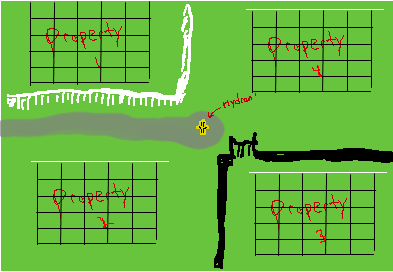
Once upon a time, some architect friends decided they would build their homes near each other at the end of a nice Cul de Sac. After looking over the grounds, each claimed that their home would be the most magnificent. So they made a friendly wager: each would help the other build their home, in exchange for money they would use to finance their own home. Thus the game was on.

The goal is to be the player with the most VP when the houses are complete by placing room plans, placing construction materials on them, connecting the structure points with plumbing, and - for big points - adding floors. Game ends after round where any player has no more Room plans.
In the first round, the burliest player will be the first player.
At the beginning of every turn, each player with less than 5 dollars receives enough dollars to bring them up to 5.
The game plays in a series of repeating phases: 1. Contract Offer phase 2. Accept Contract phase 3. Construction phase 4. Buy Materials phase

Accept Contract phase: Start with the player that has the least amount of remaining dollars, or in case of a tie, closest clockwise to player one. Each player in turn chooses a Room piece in front of another player, claims the dollar offer on it, and hands the Room to the player it belongs to, who now keeps it face up in front of them. Phase ends when all players have taken one Offer.
Construction phase:

Starting with player one, each player may now:
Buy Materials phase: Starting with player one, each player may use their dollars to buy Construction material and Pipe for the next turn.
The game is over at the end of the turn where any player has no remaining Room pieces. At this time, score each house to determine a winner.