Please Read: Details on entering the Game Design Showdown.
This month's challenge is to design a stereotypical Eurogame about the 12 trials of Hercules.
The winner of the October/November GDS, "Herculean Task," is Verb The Adjective Noun, by Isaiah Tanenbaum (ilta)!
Second place was The Labors of Herakles by Richard James (rcjames14), beating out Hercules: The Later Years by Dave (dobnarr) by just 2 votes.
Congratulations to all 4 entries, they all really look superb!
Theme Restriction: As the title implies, the theme of this month's challenge is Hercules and his 12 trials.
Mechanics Restriction: Many eurogames have been referred to as rehashes of a particular mechanism. There are many games that feature Auctions for example, and there's some question as to whether there's really much difference between them. But I am a firm believer that a game experience is more than just the sum of it's parts. I think that combining common mechanisms can definitely produce a fresh game experience. So this month I challenge you to combine at least 3 of the following stereotypical eurogame mechanisms to create a game about the 12 trials of Hercules:
Auctions (Amun-Re, Princes of Florence, Vegas Showdown, Evo, Age of Steam)
Comments or Questions: Comments and questions about this Challenge were handled on the Comments Thread.
A euro-style card game for 3-6 players
Capture the Erymanthian Boar! Clean the Augean stables! Slay the Stymphalian Birds! These are but three of the trials set before the great hero Hercules. But what of the rejected trials – the tasks left on the Olympian cutting room floor? Hercules might have been forced to “Spelunk with the Etruscan Toad,” or “Flummox the Bedazzled Gamehen!” Or perhaps you can do better?
Players are Greek gods, setting Trials before Hercules, who, being Hercules, will successfully complete exactly twelve before Zeus steps in and calls an end to the proceedings. At that point, whichever god garnered the most Laurels is declared the winner!
Notes: Steps 1 and 2 only happen when applicable, AND ALWAYS BEFORE the action phase. When you are out of cards in the draw deck, shuffle the discards to form a new draw deck. After the current player’s action, play passes to the left.
If, at the start of your turn, you have the greatest number of markers on a Challenge card in the auction pile, you win the card but lose the markers. Return other players’ (losing) bids; remove yours from the game. Replace the card with one from the deck.
Trials are “complete” if they have one Verb, one Adjective, and one Noun (note that a Trial may also have a Condition, but the Verb, Adjective, and Noun are still necessary for it to be complete).
If a Trial is complete at the start of your turn, AND you have the most markers on it (or are tied for first), do the following:
- Score ALL the laurels in the trial (tied players BOTH get full value), advancing your marker on the laurel track
- Return markers to their players
- Placed the trial out of play but in sight; no cards may affect it further
Trials are considered “open” until they are scored at the start of the scoring player’s turn.

Choose one of the following actions:
Place 1 - 3 markers on a single Challenge card in the auction pile.
Draw a Challenge card from the face-down deck. Discard a card from your hand (it can be the card you just drew) OR remove 2 of your markers from the game.
Add a Challenge card to an open Trial, or start a new one. Note the following rules:
- A Trial consists of up to one Verb, Adjective, and Noun
- You may only add an “adjacent” card to an existing Trial (ie no Verb/Noun-only trials)
- The Verb, Adjective, and Noun cards must have matching edges
- Verbs have black on the left and a color on the right; Adjectives have colors on both sides; Nouns have a color on the right and black on the left
- A Trial may also have a single Condition attached. Conditions are always black, always match, and are considered “adjacent” to any existing Challenge card in a Trial
- There can only be as many open Trials as there are players
When you play a Challenge card, place a marker of your color on that card. If it’s a Condition card, follow its rule text.
Note: if you have no markers, you can’t add a Challenge card!
Discard one or more Challenge cards from your hand. For each Laurel value shown, recover a “removed” marker (minimum 1 marker per card). Useful if you’re running low on markers late in the game.
As soon as the 12th Trial is completed and scored, the game ends. Whoever has the most Laurels at this point is the winner, and the gods hold an ambrosia bacchanalia in their honor.
(Euro mechanics: Auction, Set Collection, Worker [marker] Placement, Tile [card edge] placement)

After his labors, Hercules rested on his laurels. Literally – he had a whole pile of laurels upon which to rest. But over time, his fame faded, and he’s now badly in need of drachmas to support his lavish demigod lifestyle. You are Hercules’ new agent, trying to find him some paying gigs that fit his skillset.

Give each player 10 coins. Place the other coins in reserve. Place the game board in the center of the table. Shuffle the cards and place them in a pile face down. The player most likely to have been sired by Zeus takes the starter pawn.
Each turn has two phases described below.
Draw one card from the deck per player in the game. All but one of these should be placed face up; the last should be face down and hidden from all players. So, if there are four players, turn three cards face up and place the fourth face down. These are the cards up for bid.
The player with the starter pawn bids first by placing as many coins as she wishes on top of one of the cards. Only one bid may be placed at a time, and a player may not refuse to bid. Bidding progresses around the table to the left. Each subsequent player may either bid on an unbid card or add coins to an already-bid card. For example, if Andromeda bids two coins on a Conquer card, and Antigone adds a coin to that card, Antigone’s total bid is three coins, and Andromeda’s bid is no longer valid.
Bidding continues until each card is allocated to a player. Players cannot change their bid amounts or switch cards unless outbid. When outbid, a player may request that her coins be refunded and replaced by the higher bidder.
When bids are resolved, each player must pay the total amount they bid to collect their card. Unused coins are returned to their owners.
Deadbeat Rule: If a player bids more coins than she has, the auction is cancelled and then repeated without the deadbeat player participating. The extra unbid card is discarded.
Beginning with the starting player and moving left, players may play their cards as follows:
Draw Cards: The player discards the draw card and takes the indicated number of new cards.
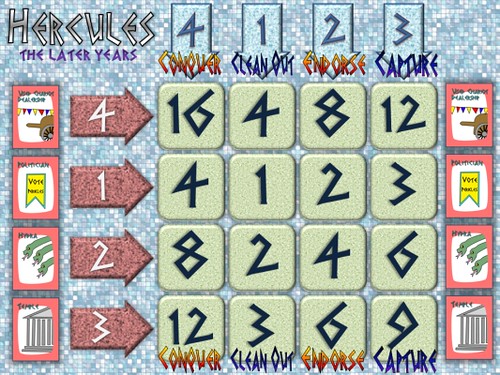
Object and Action cards: If a player has both an action (Conquer, Capture, Clean Out, Endorse) and an object (Used Chariot Dealership, Temple, Hydra, Politician), she may play them to make Hercules complete a task. The player discards the cards, takes a new coin of her color from the reserve, and places it on the game board at the appropriate spot for the action and the object.
Fees: Each action and object has a value associated with it. To determine the fee paid for the task, multiply the cards. For example, Capture has value 3 and Temple has value 2, so capturing the temple is worth 3x2=6 coins. A player who captures the temple collects a fee of 6 coins. Fees are printed on the board task spaces.
Repeating a task: The first time a task is completed, it requires only one action and one object card. Each subsequent time, the task costs one more of each. For example, the second time someone endorses a politician, it takes two Endorse cards and two Politician cards. The fee remains the same regardless of how often the task is completed. The player’s coin is placed on the board on top of any previous coins. Players may repeat tasks they’ve completed.
Bonus cards: Some action and object cards are marked double or triple. This means that they may count as more than one card when completing a task. The fee paid for the task remains the same. Players may “overpay” for a task.
Players may make as many plays as they wish. When all players have had one chance to play cards, the starter pawn goes to the next player, and a new Card Auction phase begins.
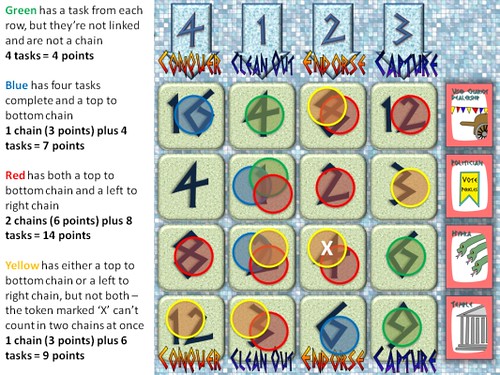
The game ends when there are not enough cards in the deck for a full card auction. At that point, the game is scored as follows:

The highest scoring player wins. For tiebreakers, use the most unspent coins and then the most unplayed cards.
Hercules has begun his Labors. He has slain the Nemean Lion and his nephew Iolaus assisted in slaying the Lernaean Hydra. Both won acclaim for their deeds.
You are an up and coming Greek youth looking to win acclaim for yourself by assisting Hercules with your strength and wit.
Each Labor is represented by a picture with a colored border, a number of boxes where dice are placed, a Target number colored to match the border, and a black number

- Players secretly choose one card from their hand and all reveal simultaneously - Players who chose Wrestle move to the top of the turn order track in order of highest card played to lowest, followed by those who didn't choose Wrestle, highest card to lowest - A 0 card beats no card, ties are broken by current turn order, discard played cards 2. Research - In turn order - Players who chose Research draw 3 cards from the draw pile, keep 2 and discard the 3rd, then either draw 1 face up card (which is replaced from the draw pile) or 1 more from the draw pile - Players who didn't choose Research draw 1 card from the draw pile, then either draw 1 face up card or 1 more from the draw pile 3. Train - Players who chose Train move up to 2 dice from their reserve pool to their active pool, players who didn't move 1 4. Assist - In turn order players place a die from their active pool into an open die space of any unresolved Labor and move their scoring marker up 1 - Players who chose Assist may then place a second die and score 1 more point

As long friend and companion to Herakles, you will join Herakles on his quest for atonement. You will help guide him towards each of the labors he must complete at the time he is best able to complete it. But you cannot help him past that point. When it comes time to perform a labor for King Eurystheus, Herakles must do so alone. So, you will have choose carefully where to go, what to do and when to do it if you hope to help Herakles earn his immortality and for yourself the favor of the gods.
24 Labor Cards
120 Adventure Cards
100 Hero Tokens (Red,Yellow,Blue,Green,Orange x 20)
13 Adventure Tokens (White)
5 Herakles Tokens (Black)
1 Gameboard

Place a Herakles token on 5 of each heroic trait.
Place a Herakles token on 0 of the epic quest track.
Give each player a set of hero tokens.
Place one hero token per player on the favor track.
Shuffle the labor cards together.
Place one labor card on each region and create a draw pile with the rest.
Shuffle the adventure cards together.
Deal each player six adventure cards.
Place one adventure card face-up next to the board to start the adventure pile.
Form an adventure draw pile with the remaining adventure cards beside it.
Assign a player to go first.
The Labors of Herakles is divided into a set of adventures. During each adventure, you will play adventure cards to direct Heracles towards one of his labors, increase his heroic skills and bet on his success. At the end of every adventure, Herakles will attempt to perform one of the three labors available. Depending upon his level of heroic skill at the time, he will either succeed or fail. If he succeeds, then you will earn favor for your efforts to prepare Herakles. If he fails, then he will have to attempt another labor and your guidance will go unrewarded. The game ends when Herakles successfully completes twelve labors. At that point, whoever has the most favor wins.
On your turn, you may either draw an adventure card or play an adventure card.

To determine whether or not Herakles succeeds at his labor compare his current skill level in each heroic trait against the skill level required by the labor for that trait. If Herakles’ current skill level > the skill requirement for each of the heroic traits, Herakles succeeds. Otherwise he fails. If, and only if, Herakles succeeds, advance each player’s marker on the favor track by one space for each hero token that player has on the completed labor and advance the Herakles token on the epic quest track by one space. Then, regardless of success or failure, return the hero tokens on that labor to each player, remove all adventure tokens from each region, discard the labor card and replace it with a new card from the labor pile.
Whenever Herakles completes twelve labors, or the labor draw pile is empty, the game ends. At that point, advance your token on the favor track by one space for each card remaining in your hand whose value is lower than the current value of Herakles’ corresponding heroic trait. After each player has advanced his token, whoever has the most favor wins.
Each heroic trait may not be lower than 1 or exceed 10. If an adventure or power would reduce or increase a heroic trait beyond those limits, ignore the effect. If an adventure or power advances a heroic trait to 9 or 10, you may place one additional hero token on any labor on the board in addition to your normal play.