Please Read: Details on entering the Game Design Showdown.
With 6 votes, the winner of the September GDS is Over There. Runners up with 5 votes each: Last Bot Standing and Nations of the World. Wheel of History, Gods and Heroes, and Shootout at El Tiroteo finished with 4, 3, and 2 votes, respectively.
Congrats to the winner and runners up (close one this time)! The critique thread is now open.
This month's challenge is to create a game which incorporates such permanent changes to some or all of its components, allowing the game world to grow or change from play to play.
It's true that in probably every case, any such permanent change could be done without physically altering game components, allowing the game to be played again from the beginning by a new group, but where's the fin in that? For this challenge, the components must change permanently and physically. When the challenge is over you're welcome to modify the game to track those changes some other way...
Theme Restriction: None.
No restriction on theme this month - be creative!
Mechanics Restriction: None.
This month you're free to be creative and use whatever mechanisms you like in your game.
Comments or Questions: Comments and questions about this Challenge were handled on the Comments Thread.
Enjoy, and good luck!
-Seth
A permanent game for two players
This war, like the next war, will be a war to end war. - David Lloyd George
“Over There” is a card-driven war game that simulates not just a single battle, but, over the course of many games, the entire First World War. As players vie for control points and inflict casualties, the terrain, technologies, and the armies themselves change forever.
Same, except: 1. Players choose their eight starting units (any mix, but no fresh leaders) and Reinforcements (must be 3:21). 2. One/both player(s) may choose to NOT place new stars 3. Place ALL researched techs in play.
On his turn, a player may do any DIFFERENT TWO of the following:
Finally, score 1 glory/controlled (occupied) point. Enemy cities are worth 2 glory, but grant you no combat bonus.
Troops can move up to their distance in any orthogonal direction. Two units may not occupy the same space but can move through if they have 2+ movement.
If movement brings an enemy unit in range, or if you choose to attack without moving, you may attack. Announce target. Both players reveal and roll 1d6/combat value (if target is in range). For every value a player rolls (modified by terrain), he applies the following:
| 1 | 2 |
|---|---|
| you are wounded/retreat (your choice) | Nothing |
| 3 | 4 |
|---|---|
| Opponent wounded/retreats (opponent’s choice) | (your choice) |
| 5+ |
|---|
| Opponent wounded+retreat |
Permanently upgrade unit on a NATURAL 6, once per combat.
Retreats move 1 away from enemy unit, which, if adjacent, “takes ground”. Cannot retreat to an occupied space. If a unit must retreat but cannot, it is wounded.
If wounded, tear off a corner. A wounded unit with one corner remaining is instead removed from play. A removed leader is destroyed. Both are worth 5 Glory for their owner this game.
Besides regular combat, each Leader has a special power you can activate, such as “over the top, boys!” (adjacent units move), “stiff upper lip” (extra defense dice), etc. These become more powerful with upgrades.
Draw your top Reinforcement. Place it face-down on one of your unoccupied cities OR on the back row of the board. If an enemy is adjacent to one or more of your unoccupied cities, one of your actions MUST be a recruit there.
Take the top tech card, ripping the corner. Show it to your opponent, then place it face-up by the board. If this was your last tech, for the next set-up BOTH PLAYERS will shuffle the next level of techs into their decks.
Persistent techs change the rules. Example: “Propaganda” changes your “recruit” action to draw 2/select 1, forever. Some persistent techs require you to destroy conflicting techs.
Some techs are obsolesced when the next-level tech appears; destroy them.
Techs with activation powers (“Dig In”, “Air Recon”, “Artillery”, etc) may be activated, as with Leaders. Once-per-game techs (“Poison Gas”, “Better Weapons”) are flipped to indicate use.
The game ends IMMEDIATELY if you achieve your objective or possess 30 Glory. You win!
Alternately, when a player runs out of recruitment cards, whoever has more Glory wins.
Winning side and score is marked. Winner does ONE of these:
Loser chooses a DIFFERENT benefit.
If a player occupies ALL enemy cities at game end, they win the war. Alternately, whoever has won the most games out of 20.
This is not a fully developed game idea, but enough to make a GDS entry. Players start their first game by creating a landscape for their game. Then they travel these lands with heroes making wars and trades.
Each player start out with a quite large hex divided into 54 triangles. This is the blank canvas for the gods to paint. The players place certain shaped landscape forms to make their creation complete. Blue is water, green is forest, grey is mountains and brown is desert. The rest of the triangles are white or yellow and signifies fields.
When all the players have finished their design the hexes are put together as the game board. Each hex must share borders with 2 or more other hexes. The last player to finish his creation places his landscape first, continue with the second last and so on.

The players found their capital city somewhere in their own hex. Cities are represented by a red triangle that covers up one of the landscape triangles. The earlier landscape type of the city site is ignored from that day. Cities cannot be founded on water triangles. The players mark their capital city with a chosen letter. The same letter is used on all things that require to be marked in this game, so choose wisely.
The moving pieces of the game are heroes. Each player has 3 heroes and each hero is represented by a piece on the game board and a stats card in front of the actual player. The stats on a hero card will be speed (distance that can be traveled each turn), tactics (or something) to influence battles and diplomatic/trading skills to gain resources in foreign cities. Moving costs movement points, 1mp when moving out of a forest, desert or field triangle, 2mp when moving out of a mountain triangle. Building a boat is needed to cross a water triangle. You cannot end your turn on a desert triangle. The heroes have special abilities that help them founding cities, collecting resources or recruiting troops.
During a game players may found new cities to expand their possibilities. Cities provide places to recruit troops and gather resources but are also places needed to be defended from hostile neighbors. Resources are gathered from triangles adjacent to the city triangle. Lumber from forests, stone from mountains and various metals (gold, silver, iron) by mining in the mountains. Fields provide food which is important when recruiting troops.
Some points for each city controlled (1pt for own cities, 2 pts for foreign cities and 3 pts for a capital), maybe points for conquering during the game and maybe building on a common wonder gives the players victory points. This is not finished thinking.
When a city is founded it stays on the board forever. A capital city is never changed but at the end of the game all other cities are marked with the letter of the controlling player. In later games this gives the city population loyalty to that player, making it easier to negotiate with that city. A city may have loyalty to multiple players after multiple games. At the end of a game players give two of their heroes an upgrade of 1 on one of the stats described earlier. The upgrade is noted on the card. All three heroes receive 1 loyalty point to that player (mark the hero with your letter). In later games this gives the hero loyalty to that player, making it more difficult to attack that player if the hero is played by another player. Heroes may, like cities, have loyalty to multiple players after multiple games. Heroes may change player from game to game. So you have to adapt to your heroes’ loyalty and skills each game to reach control of as many cities as possible. You start in your capital city and rushes to secure your nearest cities before moving on to other territories...
If a new player at any time enters the game (of course not during a game, but before starting) (s)he creates a new land hex and places it on an appropriate place on the board. And then proceeds to founding a capital city AND as many more cities as found on the hex with the least number of cities on the board.
The game where history repeats itself. For 2-6. Blank cards and starter decks available online at
If there are any new players, you’ll need a starter deck. If all players are new, you’ll need a starter echo deck too.
For each new player, deal 12 random cards from the starter deck into the draw deck.
Each returning player adds 12 province cards of their choice from the previous game into the draw deck.
Shuffle the draw deck and deal 8 cards to each new player and 4 to each returning player. These are the opening hands. Each returning player adds their 4 keeper provinces to their hand.
Shuffle the echo deck generated during the last game.
Set aside a stack of blank cards.
Set aside the reference sheet with the available abilities on it.
There are two types of cards in this game:
Echo cards have a one-time game effect.
Province cards have abilities which give you resources, and others than can be activated for benefit. They come in five levels:
Note: when you discard a card, place it in the discard pile. When you raze a card, rip it up and throw it away.
The game is played in 15 rounds, each of which has 4 phases:
• Echo Phase: Reveal the top card of the echo deck, follow its instructions, then raze it (some echos are razed at the end of the round or later in the game, so read it carefully).
• Build Phase: Going clockwise in turn order each player may:
- Found a settlement
OR
- Play a province from hand
OR
- Upgrade one of their provinces in play
Each player may only do one thing during each build phase.
• Produce Phase: Each province with a produce ability (+gold, +food, +cards) produces that resource. +cards means you draw that many random cards from the draw deck.
• Buy Phase: Going clockwise in turn order, each player may activate any number of activated abilities on their provinces. Each player has only one opportunity to use abilities this phase, but may use any number of abilities during that time. Activated abilities show the amount of resources you must pay, followed by an arrow, followed by the effect.
Ex: 4 gold -> War means you may pay 4 gold to declare war.
Activated abilities may allow you to:
• trade food for gold or vice versa
• trade with other players
• declare a war (see War)
• gain monuments
• generate echo cards for the next game.
• etc.
• Upkeep Phase: For each province a player has in play, that player must spend food equal to its upkeep cost or discard it. Upkeep cost depends on the province’s level.
After the 15th round, whoever has the most monuments wins. Then each player chooses 4 of their provinces in play and/or hand to be their keepers next game. Draft the remaining provinces in play, hands, discard pile, and draw deck until each player has chosen 12. Raze all unused echo cards and unchosen provinces.
To found a settlement, take a blank settlement. Write a name on it, and write one level 1 ability on it, then put it in play.
Level 1 abilities:
• +3 food
• +1 gold
• 2 food -> 1 gold
etc.
To upgrade one of your provinces to the next level, you must pay gold equal to its upgrade cost. Then take a blank card of one higher level, copy the province’s name and abilities onto the new card, then add one new ability of it’s new level of lower. For example, when you upgrade a village (2) into a city (3), you may add a level 3, 2, or 1, ability. Finally raze the old card.
Echo cards come in five colors. To generate an echo card, activate an ability. Ex: 3 gold -> generate red Echo. Choose one of the echo effects of that color (see table 6), write it on a blank echo card, name it, and set it aside. It will form part of the echo deck next game.
Red echo:
• Famine | Each player loses 3 food
• Peace | Wars can’t be fought this round. Raze at end of round.
...
Choose a province for the warring province to fight. You and the warring province’s owner each discard a card from your hand face-down. Reveal the discarded cards, and add their level to that of the involved provinces. Whoever has the lower total crosses out one of the abilities on their province. If tied, both players lose.

Checking Systems....
Systems Diagnosis Complete
No errors detected.
Activating sub-routine KILL.
It's the day of the fight and you've done all the debugging, compiling and tweaking that any one person can do. All that's left is to place your creation into the compound, watch and wait.
3-4
8 six-sided die
4 map sheets
8 tiles (5 wreckage tiles, 3 bot tiles)
1 rulebook
4 bot sheets
100 bot part tiles
Eliminate all opponents.
Each player rolls a die and places their bot on the appropriate spot. Debris tiles are placed on the two remaining starting positions.
The map is left as is for the first game. On subsequent games, players have the opportunity to add walls and/or debris to the map, representing rebuilding after the previous match.
Players with no bots start with $1000 to purchase parts. Veteran players may use their winnings to purchase new parts or repair their bot.
A player may do each of the following in any order on a turn:
- move
- attack
- other
Depending on the equipment, a bot may have anywhere from 1 to 7 movement points(MP). Turning a bot uses a movement point. If a bot is not using the full charge of it's battery, it may use the remaining charges to make an additional movement. If a bot does not have a functioning sensor then roll Xd6. (X is the bot's MP value.) The bot will move according to the chart (The player can decide in what order to perform each movement):
1. Forward
2. Left
3. Right
4. Backwards
5. Turn right
6. Turn left
Unless a bot is equipped with a turret, it must be facing the bot, door, wall or debris that it wishes to attack. As long as these are within range and in line of sight, an attack may be initiated. Compare the attacker's offense to the defender's defense rating. (A door has defense 1, wall 2, and debris 4) The difference equals damage dealt. Roll 1d6 to determine where the defender was hit.
1. Chassis/Battery
2. Locomotive
3. Sensors
4. Offensive
5. Defensive
6. Accesories
A bot equipped with accessories may perform additional actions:
- Lay a trap (Betty, Oil Slick, Sticky Goo)
- Raid debris (Search debris for parts and assimilate)
- Remove wall (requires saw or claw)
- Add wall (requires claw and wall)
The game continues until only one bot remains. That bot is victorious.
The surviving bot earns the combined cash value of the defeated bots.
The last bot to be defeated earns it's own cash value.
Ammo Box - accessory - doubles ammo capacity
Battery, Heavy - can power up to 8 components
Battery, Light - can power up to 4 components
Battery, Medium - can power up to 6 components
Betty - accessory - hits everything in a 1 square radius for 1d6 damage
Bipedal - locomotion - MP 1, basic equipment
Chassis, Heavy - can support up to 7 components
Chassis, Light - can support up to 3 components
Chassis, Medium - can support up to 5 components
Claws - offensive - range 1 - roll 1d6, 1: opponent's MP next turn is 0
Cloak - defensive - cannot be targeted by optical sensors
Flamethrower - offensive - range 3, disables thermal sensor for next turn, roll 1d6, 1: thermal sensor is destroyed
Goo - accessory - used in combination with Sprayer, reduces opponent's MP next turn to 0
Hover - locomotion - MP 7
Laser - offensive - range 6, unlimited ammo, ATK 2, roll 1d6, 3: disable optical sensor next turn
Oil Slick - accessory - used in combination with Sprayer, causes bot to lose control
Optical Array - sensor - basic equipment
Projectile - offensive - range 4, 20 ammo, ATK 5
Quarduped - locomotion - MP 2, can carry 1 additional component
Saw - offensive - range 1, automatically destroys doors/walls
Shield, Energy - defensive - +1 DEF to laser and flamethrower
Shield, Physical - defensive - +1 DEF to projectile, claws and saw
Sprayer - accessory - lay oil slick or goo
Thermal Array - sensor - can see past Cloak, can be disabled/destroyed by Flamethrower
Tracks - locomotion - MP 3
Turret - accessory - allows bot to shoot in any direction
Wheels - locomotion - MP 5

Shootout in El Tiroteo is an Old Western delivery game where players are competing to harvest resources and avoid getting shot along the way. Every turn new events, items, passengers, and buildings arrive on the train and cause new gunslingers to block your victory in El Tiroteo.
The object is to get 15 VPs by constructing buildings, trading resources, and winning shootouts. The game ends after the turn when a player gains 15 VPs.
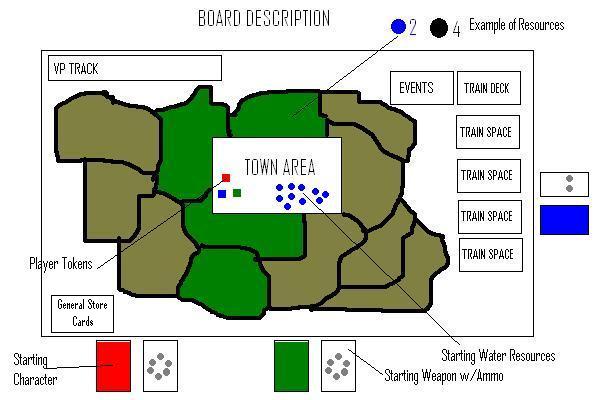
The board shows a town with some buildings, train spaces on the side, a VP track in a corner, and lots of surrounding regions in which to gather resources. To set up the board, each player takes a resource chip to represent their color and places it on the VP track. Then place the remaining resources in each region that has that resource number listed. Also, place 10 Water into the well to start the game. To set up the players, each player draws cards from the train deck until they receive a character; they also receive a colored figure to represent their character. These are placed on the town. Then take that characters starting weapon and fill the ammo capacity with metal tokens. The resources are used in different ways. They can be traded in at buildings for resources or used as money to buy items.
There are five factions in the game: The Caballeros, The Lawmen, The Outlaws, The Apaches, and The Prospectors. Each has special abilities and has two enemies. For example: The Lawmen’s special abilities are to throw people in jail If they kill someone (unless they pay you some resources) for 2 turns, where they can’t do anything, or they can put wanted posters up for characters that reward players for killing certain people. These wanted posters will remain on the board for future games until someone succeeds. Their enemies are the Apache and the Outlaws. Enemies are the only characters you can have a shootout with.
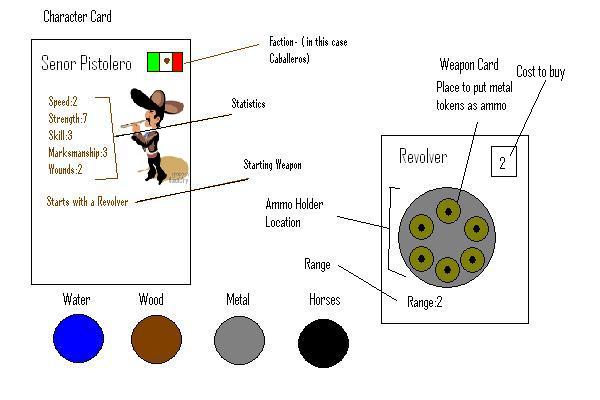
Each character card is listed with a starting weapon, a faction symbol, and 5 statistics. Starting weapons can be a revolver, shotgun, or rifle. The factions are listed above. The 5 Stats are: Speed, Strength, Skill, Marksmanship, and Wounds. Speed is how far your character can move on the board each turn. Strength is how many items and resources you can carry. Skill is used to show how many dice are rolled when harvesting resources. Marksmanship shows how many dice you can re-roll. And wounds are how many hits you can take before you lose all resources and must take a new character from the train deck.
At the beginning of the round, all train cards still on the train will be discarded to the bottom of the deck. The train will then be refilled. When a player moves into a space, he may harvest resources in that spaces by rolling dice equal to his Skill. A successful roll may take any resource remaining in that space if meeting difficulty requirements. For example, if a 5 is rolled in a space with Horses, Water, and Wood would let that player choose any of those resources. If he ends in the town he may take 2 actions with any of the buildings on the board including the train station to bring more cards into play, shopping at the general store, building new buildings, or trading in resources for VPs. The round ends when everyone is finished with their actions. NPCs stay in town.
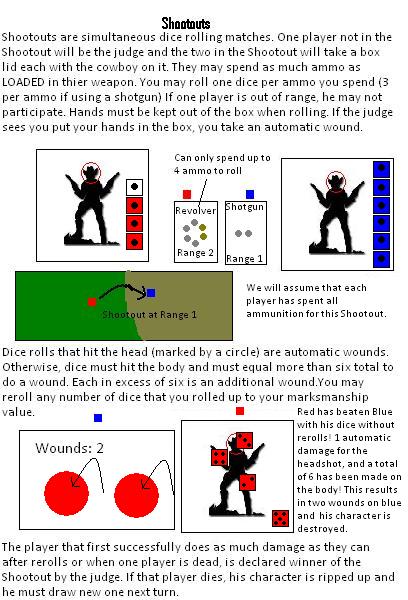
Shootouts happen when any character, comes within range of their weapon.
4-9 players
The nations of the world gather, as they are wont to do, and argue about the distribution of the world's resources and wealth…also as they are wont to do. After each game the conditions in the world will change, and nations will adjust to their new found resources, making their strategies evolve each game.
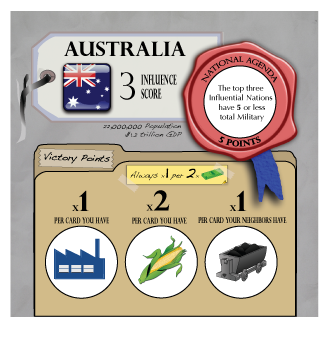
Your GOAL, as the representative of one of these nations, is to ensure that your country walks away with as much of the resources that it needs as possible while trying to meet your National Agenda.
As Nations, players will be forming and breaking alliances to get votes and to votes and resources that earn points at the end of the game. Each game ends with Nations Evolving and a new Global Shift. See "Game End"
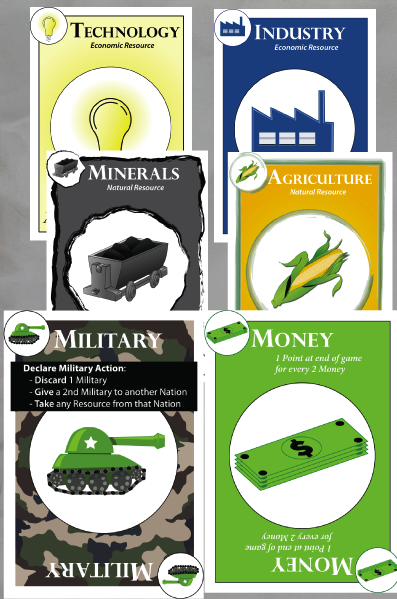
Resources, Money, and Military are depicted on cards shuffled together to form the Resource Deck.

The game play is quite simple, as the nature of this game is meta-game politics over card mechanics. Therefore, there are two sand-timers (each about 2 minutes) to determine when rounds should progress.
Each player takes a Nation mat and two cards from the Resource deck, which is shuffled and placed on the board.

The player who's Nation has the highest Influence score begins with The Floor.
"The Floor" determines who may make the first proposal during the debate each round. Each turn it will pass to the next Nation in descending Influence Order, and then back the other way.

Votes:
In order to pass a proposal, it must receive votes from more than half the total Influence in the game (ex. if there are seven players, with influence scores of 1,1,3,2,2,1,3, then a vote will need 7 votes to pass).
If a Proposal passes, The Floor divides/discards the Resources as declared (Players may propose to do anything with the Resources, including tearing up the card).
If a Proposal fails, The Floor passes to the next Nation who must immediately make a new Proposal. A Timer is started again, at the end of which another Vote is called.
If three consecutive Proposals fail, then all the Resource cards on the board are discarded.
The game ends at the end of the round when either:
At this time players may no longer alter their hand or make bargains. They score their National Agenda (if they succeeded in achieving it), as well as score for their Resources cards according to their Nation mat. Highest score wins, or may result in a tie.
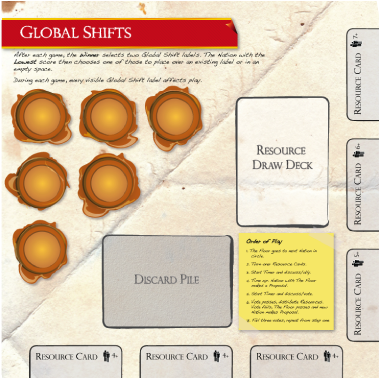
Finally, all Nations Evolve, and there is a Global shift to affect future games.
Nations Evolve:
Each Nation may replace one of the Resource icons on their Nation mat with an icon of a Resource they had the LEAST of (including if they had none of that Resource)
Secondly, the Nation with the Lowest score may change their National Agenda with a new National Agenda sticker.
Global Shift
This represents conditions in the world changing between games, and effects range from "Drought - discard up to one Food from board each round" to "Militarization - The Floor replaces one Resource on board with a Military from the deck"
After each game, the Winner selects two Global Shift stickers. The Nation with the Lowest score then chooses one of these to place over an existing sticker, or in an empty space on the board.