Please Read: Details on entering the Game Design Showdown.
VOTING RESULTS ARE IN for the September 2010 Game Design Showdown entries!
Photo finish this month! Congratulations to Richard James (rcjames) for garnering 8 votes with his cooperative game entry Nottingham!
Runner up in 2nd place with 6 votes was (dplepage) for Sherwood Irregulars.
Thanks everyone for participating, I really liked several of the entries this time! The critique thread is now open for business!
Theme Restriction: This month's theme restriction is very rich and recognizable to all: Robin Hood! There have been a few published games with this theme, but none I would consider great... maybe you can do better?
Mechanics Restriction: To go along with the theme, your game must have some semblance of "stealing from the rich and giving to the poor".
Mechanics Restriction: Your game must also include at least two different mini-games. For an example of a mini-game, consider Archon, a Chess style game where you play a mini-game to see which piece actually wins in a capture.
Please follow the established guidelines for formatting and submission of your entry.
Comments or Questions: Comments and questions about this Challenge were handled on the Comments Thread.
4-6 players Playing time 10-20 minutes
One night around the campfire, Robin's band of merry men gets a-arguing; who's the best bandit of them all? A challenge is set; He who steals the most gold from the rich to give to the poor will be heralded as the winner.
2 players
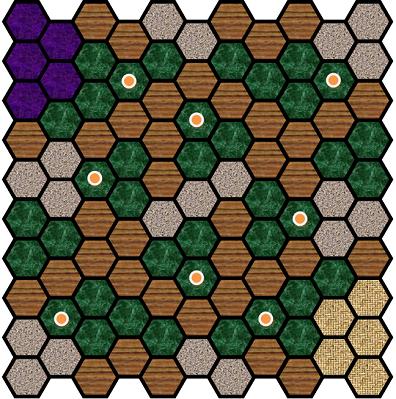
Gameboard (see illustration)
3d6
2 battle decks of 20 cards (see illustration)
6 “band” boards/tokens
2 sets of 20 tokens
4 RECRUIT markers
4 TAX markers
30 Gold markers
Gameboard:
Battle Cards:
Eliminate all of opponents’ tokens or score 100pts in gold.
Law (Nottingham Lawmen acting on the Sheriff’s behalf) and Merry Men (MM) (acting on Robin Hood’s behalf).
2 tokens are placed on each “band” card and 1 token on 3 home spaces for each player. Law gets the purple spaces (Nottingham), and MM gets the tan spaces (Robin’s Hideout in Sherwood Forest). Law tokens cannot enter the Hideout, and MM tokens cannot enter Nottingham.
Law places a band token on any town. MM then places a band token on any forest space with a circle on it. Alternate until all band tokens are placed. Law player begins.
Law tokens on road spaces (brown) may redo a single loss in battle, and Law bands carrying gold that start on Nottingham or road spaces get +1 to movement. These bonuses apply to MM tokens on Hideout or forest spaces (green).
move 2 band tokens, or divide the total of 2d6 across your single tokens any way you choose.
Band cards have 10 spaces, numbered X-X-5-3-3-2-2-2-1-1. When you add members (past the first 2) or gold to a band, you must add them so that they cover the highest uncovered space on the band card.
When you move a band token, it moves an amount of spaces equal to the highest UNCOVERED space on the band card (if there are 5 tokens and/or gold on a band card, it may move 2 spaces – the X, X, 5, 3 and 3 will be covered, leaving a “2” visible). You may choose to leave behind one member of the band in the space that it previously occupied when you move it, but there must be at least 2 tokens remaining on the band card (even if the remaining spaces are filled with gold). The more members or gold in a band, the slower it will move. When a token or gold is removed from a band card, shift the remaining ones so that the highest possible numbers on the band card are always covered.
If 2 of your tokens occupy the same space combine them into a band and place them on a band card if you have a free one – if not, they can’t occupy the same space. If 2 opposing tokens occupy the same space, battle.
Players draw 3 cards from their battle decks (their hand), choose one card from it, place it face down and draw to replace it. Then, reveal them. The losing player removes a token from the board or their band card until one side is eliminated. On ties, nothing happens.
The order of the cards (Rock-Paper-Scissors) is: SWORD beats SPEAR beats HORSE beats SWORD. FIRE beats everything.
If the losing player held gold, the band or token that won takes it. Bands may hold as many gold markers as they have empty spaces. Single tokens may only hold one gold marker. If a band is reduced to 1 member, remove it and all gold from the band card and place it on the board. Any unclaimed gold markers remain on the space where they were dropped. Tokens may return to that space to pick it up on a later turn.
In towns, Law may Tax, MM may score gold pts, and both players may recruit. Any gold Law gets in Tax must be brought back to Nottingham to score gold pts.
To recruit, roll 3d6 (separately), and add a token to the band if the die roll is more than the number of men CURRENTLY in the band (with more men, you’re less likely to recruit new men). If Law recruits in a town, place a RECRUIT marker there. Law may not tax there, MM may not recruit there.
To tax, Law rolls 1d6 for each band member, separately, and adds a gold to the band if the die roll is more than the number of gold CURRENTLY in the band (with more gold, you’re less likely to get gold). If Law taxes a town, place a TAX marker there. Law may not recruit there.
There may not be more than 30 gold in play at any time.
When Law bands arrive at Nottingham with gold, discard it, roll 1d6 for each marker and score the total in gold points.
When MM bands with arrive in a town, discard the gold, roll 1d6 for each marker and score the total in gold points. If the town has a RECRUIT marker in it, roll 1d6 for each 2 gold markers.
A notorious bandit has been stealing from the good people of Nottingham. You have been hired by the Sheriff to capture the leader of this band of outlaws, the infamous Robin Hood.
To make sure that a number of coins make it to the Treasury before King Richard returns to England and to have captured the most number of outlaws.
Game board with village and forest locations around Nottingham, a Camp with Robin's Men, a Jail with player-colored cells, the Treasury, the Tax Collector's chest, a turn track with 10 spaces, and a captured outlaw track.
When capturing an outlaw, move one from the Camp to the player's colored Jail cell and increase that player's marker on the captured outlaws track.
When stealing coins, Robin's men remove coins from the game.
An Anti-Robin Hood Cooperative Game

It's tough to rule a kingdom while the king is away. Doubly so when there's some uppity son of a lord who thinks he's Robin Hood. There are taxes to collect, barons to control and castles to build. The last thing that you need is a bunch of lawless riff-raff in the local forest intercepting your bribes. Luckily, you are not the only one who suffers at the hands of these 'merry' men. As the Prince, Merchant, Constable, Bishop, Baroness, Abbess and Sheriff of Nottingham, you all stand to loose your head if you cannot stop the banditry and deliver the fortune in gold you promised the Barons before the king returns. But, to do so, you will have to work together, keep Sherwood Forest clear of ‘merry’ men and uncover the one of you is secretly supporting this infamous Legend of Loxley.

At the beginning of the game, each player is dealt a character as well as a loyalty card face down. Based upon the loyalty card you are dealt, you are either an Usurper or working for Robin Hood’s men. Each player is then dealt two Sherwood cards and a number of cards from each of the Nottingham decks = the number listed on his character card.
The Usurpers win if they deliver 50 thousand pounds of gold to the barons before King Richard returns. Robin Hood wins if the king returns before enough bribes are delivered.
At the beginning of your turn, you must play a Sherwood card from your hand. These cards represent the forces of Robin Hood at work against your plans to usurp the throne. The Sherwood Deck is made up of ‘Merry Men’, ‘Robin Hood’, ‘Maid Marian’ and ‘King Richard’ cards.
King Richard returns whenever all five spaces on the Crusades track are full. In general, this is done by playing five of the twelve ‘King Richard’ cards in the Sherwood Deck, but some cards in the Nottingham deck may be played to delay the king.
There are three types of Nottingham cards: Soldiers, Clergy and Merchants. These card represent the forces of Nottingham who you can strong-arm into working for you. Each Nottingham card describes an action on it as well as a location. In order to perform the action on a card, your character must be located in its location. Each card also lists the tax value that it provides if it is revealed by a Collect Taxes action.
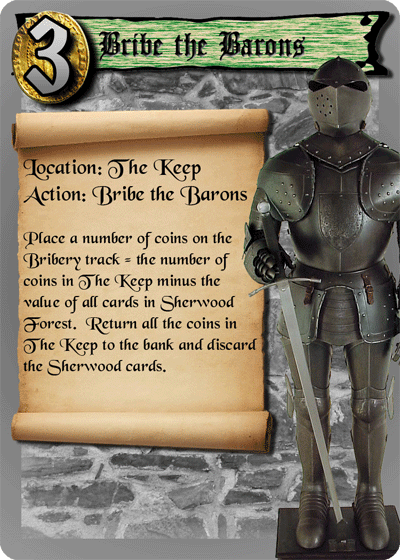
Sherwood Forest stands between Nottingham and Northern England. Whenever you wish to send gold to the Barons, you must send it through Sherwood Forest and some (or all) of it may be stolen by Robin Hood’s men. Whenever a player plays a card to Bribe the Barons, reveal all the Sherwood cards in the Sherwood Forest pile. Subtract the total value of the cards from the number of coins in The Keep and add a number of coins to the Bribery track = the result. Then, remove the coins in The Keep, discard the Sherwood cards and place a new one on the first space from the deck in Sherwood Forest.

You raise money to bribe the barons by fleecing the peasants in Nottingham. Whenever a player plays a card to Collect Taxes, turn over all Nottingham cards located in the zone where the tax is collected. Add up the tax value of each card, then add a number of coins to The Keep = the total tax value collected minus the number of corruption tokens in all zones (the Cathedral, Castle or Joust Arena).
When it is your turn, you must first play one of the Sherwood cards in your hand. You may either play the Sherwood card face up in front of you and resolve its effect immediately or place it face down in Sherwood Forest. Then draw a new card from the Sherwood deck to replace it. You may then perform any two of the following actions:
Once you perform your two actions, you may then place any number of cards in your hand face down onto either the Toll Bridge, Abbey or Village. Then, draw a number of cards from each of the three Nottingham decks = the number listed on your character’s card. Then your turn is over and it is the next player’s in clockwise order.
An asymmetric game for 4 Players vs 1 Player
Four Merry Men of Sherwood Forest steal treasure from the King's Coaches and deliver it to the inhabitants of Sherwood, while the Sheriff of Nottingham attempts to prevent them.

Divide one deck into suits, and give each Merry Man the 2-7 of a suit (their "combat" cards). Set aside the 8-K of Diamonds from the same deck (the "victory" cards), and give the 3-8 of Clubs from the other deck to the Sheriff (his "combat" cards). These will be used for the Waylaying minigame. The rest of the second deck will be used for the Robbery minigame. Put each Merry Man on one of the stars; put the Sheriff on the castle gate.
The game proceeds in a series of rounds, which have four phases:
New coaches arrive on every other round, starting with the third. When a new coach arrives, turn over the top Coach card. It will indicate which of the four coach routes this coach is taking, how many Guards are on board to protect the treasure, and how much treasure this coach holds. Put that many treasure counters on the Coach card, and put a new Coach piece at the start of that route.
Move each coach 7 spaces along its route. If a coach moves through a Merry Man, it stops on that space and all Merry Men there attempt to Rob it (see below).
The Merry Men each get 12 movement points per turn; they may spend two of these to move onto a space containing road, field, or a hut, or three to move onto a space containing forest. The Merry Men may intersperse their moves however they want and may moves simultaneously (i.e. to jointly attack the Sheriff or a Coach). They can move orthogonally or diagonally.
The Sheriff of Nottingham, being on a horse, moves much faster than the Merry Men, but can't enter the thick forests of Sherwood. He may move up to 14 spaces on his turn, but only on Road or Field squares, and only orthogonally.
The Merry Men win if every hut has a treasure token. The Sheriff wins if the last coach reaches the castle before the Merry Men have won.
The attacking Merry Men play against the Sheriff, using their combat cards to try to win the victory cards. Shuffle the victory cards and turn one face up. Each player plays a card face down, then all players reveal them simultaneously. The player with the highest card showing takes the victory card; in case of ties, nobody wins the card. Repeat this process until all the combat cards have been played; whichever side's victory cards have the highest sum wins; the Sheriff wins on ties. Jacks, Queens and Kings count as 11, 12, and 13, respectively.
The attacking Merry Men play against the Guards (the Sheriff plays their side) when they raid a Coach. Shuffle the Robbery deck and deal 4 cards to each Merry Man, 6 to the Sheriff. Deal one card face up in the middle of the table for each Guard on the coach, then turn over the top card of the deck to start the play pile. The players take turns in clockwise order. The player to the Sheriff's left goes first. Each player on his turn either plays a card of the same number or suit as the top card of the deck, or draws a card from the deck. If a player other than the Sheriff plays a card with the same number as one of the Guard cards, that player must pick up the corresponding Guard card. The first player to empty his or her hand wins the Robbery.
2-4 players
You are competing to join Robin Hood’s band of rogues. Robin prepares a contest: be the first to steal 8 shillings worth of loot and return it to the Outlaw Camp, and he’ll accept you into his band.
Place the Loot tokens as follows:
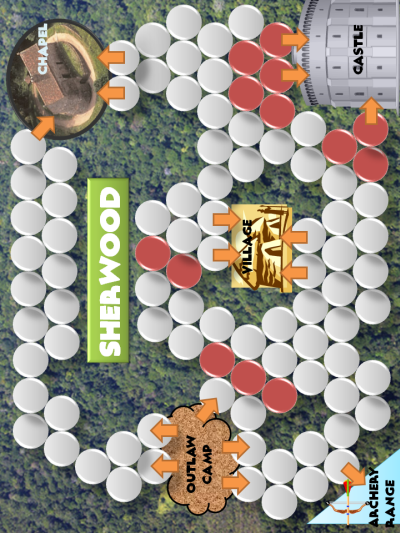
Chapel: 2 x 1 shilling, 3 x 2 shilling
Castle: 5 x 3 shilling
Village: 3 x 1 shilling, 2 x 2 shilling
Each player starts with 3 Merry Men and 1 Cart in the Outlaw Camp. Place the other resources in reserve off the board. Each player also gets 3 arrow tokens.
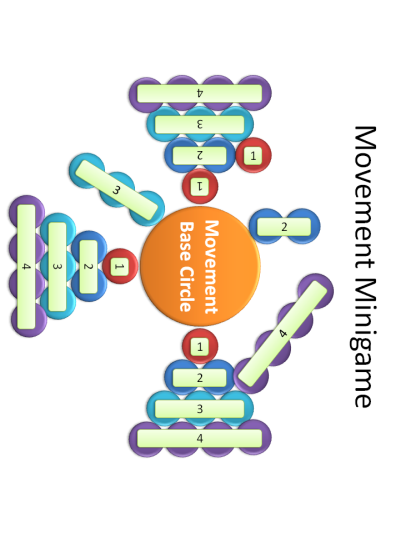
Set up the Movement Minigame to one side. Build a pyramid of four movement tiles numbered 1-4, with the 1-space tile touching the Movement Base Circle as shown in the Movement Minigame image below. Make one pyramid for each player playing.

The game plays as follows:
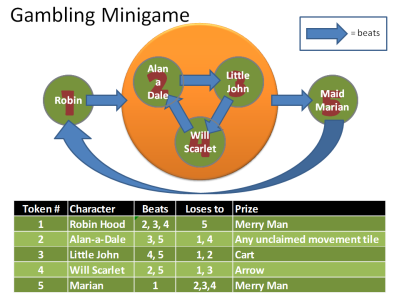
1. Gambling Minigame – each player has five gambling tokens with five different characters on them as shown:

Each player chooses one character in secret. All players reveal their choices. If your character is not beaten by any other, you get the prize indicated. New carts and men are placed on the Outlaw Camp. Movement Tiles are chosen from the Movement Minigame.
The Gambling Minigame also determines move order, with the lowest numbered token going first. If there are ties, the player with the least treasure goes first. If there are still ties, the player who moved later in the previous turn goes first. On the very first turn, the player with the longest criminal record goes first.
Movement Minigame – on his or her turn, a player claims one movement tile by playing a movement tile marker on an unclaimed movement tiles. The player may only claim a tile if it is touching the Movement Base Circle OR if it is touching a tile he or she has already claimed. For example, on his first turn, a player can claim a #1 movement tile that touches the Base Circle. On his second turn, he can claim the #2 tile touching the #1 tile, or he could claim a second #1 tile.
Movement – Once all players have made their moves in the Movement Minigame, they may collect movement tiles and make moves. If a player elects to collect his claimed movement tiles, he takes all the movement tiles he has marked. If this leaves any unclaimed movement tiles unconnected to any other tiles, the player to the left of the current player MUST shift these movement tiles so that they either (1) touch the Movement Base Circle or (2) touch two other movement tiles in the Movement Minigame. The tiles can have any orientation provided they obey the placement rules.
Players spend movement tiles to move pieces. A player may play one movement tile per turn. When a player plays a movement tile, he may move each of his men up to the number of spaces shown on the movement tile. Multiple men may be stacked on the same space.
A player must play an arrow token or discard a man token to enter a red guard space. Similarly, if a player wishes to move a man onto a space with another player’s man, he must play an arrow token or sacrifice a man token.
Carts can only move with a man. They move one space less than the move tile played (so they cannot move at all on a 1-space tile).
When a player plays a movement tile, the player to his left returns the tile to the Movement Minigame in any legal position as above (i.e. touching the Base Circle or touching two other movement tiles).
When all players have moved, start over with the gambling minigame.
A man entering a space containing loot may collect one loot counter. A man can carry loot worth 1 shilling. He needs a cart to carry loot worth 2 or 3 shillings. Players score loot by bringing it back to the Outlaw Camp. Men and carts cannot carry multiple treasures at once.
When a man enters the Archery Range, the player collects two arrow tokens. A given man cannot collect more arrows until he visits the Outlaw Camp again.
The first player to return a total value of 8 shillings of loot to the outlaw camp wins.